Colosseum
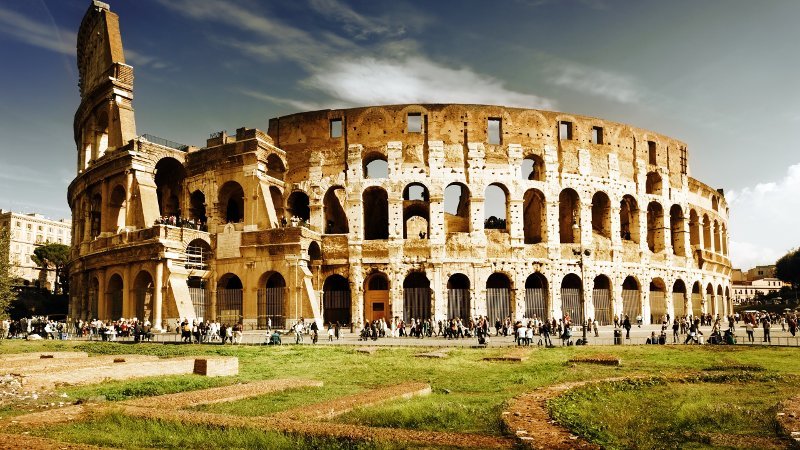
Half circus, half sports arena, Rome’s most famous classical ruin is unmissable – especially now that they have extended the visitor route to the underfloor passageways through which gladiators and wild beasts made their entrances. The massive arena – officially called the Amphiteatrum Flavium – was inaugurated in 80 AD, and seated well over 50,000 people in its neatly arranged stands: emperor, aristos and Vestal Virgins down the front; plebs, slaves and all the other women up the top. Some 5,000 wild beasts were killed for the gory opening event. By the time the last man vs beast fights took place in 523, the wild animal population of north Africa had been decimated. Occasionally though, the felines were fed too: any malefactor handed down a sentence of damnatio ad bestias was simply ushered unarmed into the arena and left there to make a lion's lunch. The ticket office queues can be daunting: those in the know purchase tickets at the quieter Palatine entrance (Via San Gregorio 30). In high season, I also recommend purchasing tickets in advance, through
Opening times: Daily, 8.30am-sunset
Price: €12; EU citizens aged 18-25, €7.50; children under 18, free; ticket also covers the Roman Forum and Palatine. Price varies during special exhibitions
Payment type: credit cards accepted
Reservations: recommended
Vatican Museums

It's tempting to think of this vast repository as “the rooms full of papally collected or commissioned art that you have to schlep through to get to the Sistine Chapel”. But in fact there’s plenty to enjoy along the way, from stunning classical statues such as the Laocoon, to Pinturicchio’s delightful Borgia Room frescoes, from magnificent decorations by Raphael to an Egyptian museum complete with mummies. However, there's no denying that Michelangelo's masterpiece, vibrant after its end-of-millennium restoration, is the big draw here - it's just a shame it's so crowded (if you're first in at 9am and rush straight through to the Chapel, you might buy yourself a few minutes' peace). I won't mention here that I once had the privilege of going up on the scaffolding while they were restoring it, as it wouldn't be fair. The dress code for St Peter's (no bare shoulders or midriff, no very short shorts or skirts) applies to the museums too: cover up, or you risk being turned away at the door. This is one Roman sight that benefits from a little forward planning: you should book a timed slot via the website, or be prepared for a long queue. Note also that last entry is a good two hours before closing time, and be aware that the Vatican Museums close on Vatican holidays, which don't always coincide with Italian public holidays - check the list on the website.
Opening times: Mon-Sat, 9am-6pm (last entry 4pm); last Sun of month, 9am-2pm (last entry 12.30pm)
Price: €16; children 6-18, students with ID under 26, €8; children under 6, free; online booking fee €4. Museums are open and free for all visitors on last Sunday of every month
Payment type: credit cards accepted
Reservations: recommended
Appian Way & Catacombs

Constructed from 312 BC to move troops and goods swiftly between the metropolis and the south, the Appian Way was also the well-off ancient Roman's burial venue of choice. Few of the impressive mausoleums remain above ground (the tall round tomb of Cecilia Metella, and the Mausoleum of Romulus – reopened in 2014 after a 20-year restoration – being the exceptions): their decorations and masonry were too tempting for future generations seeking building materials. But beneath what is now a pleasant, semi-rural lane – some of it with the original basalt paving slabs still in place – lie many miles of catacombs where early Christians were laid to rest under the watchful eye of the pagan authorities. Largest and most rewarding of all the catacombs are those of San Callisto, where nine popes and dozens of martyrs were among those stacked in 18 miles of tunnel.
Opening times: Mon, Tue, Thu-Sun, 9am-noon, 2-5pm
Price: €8; children 6-15, €5; 6 and under, free
Payment type: credit cards accepted
Reservations: not possible
Ara Pacis

In 13BC the Emperor Augustus marched home from three years of imposing peace on his formerly fractious empire, and the Senate promptly commissioned a monument to mark his achievements. Four years later, the Ara Pacis Augustae – the Augustan altar of peace – was inaugurated: a simple altar at the centre of four marble walls gloriously carved with friezes hailing the emperor, his family, piety, peace and the prosperity of the pacified Empire. The altar didn't originally stand here: it was pieced together in the early 20th century from scattered fragments. Now housed in a hyper-modern (and widely unloved) outer shell designed by US architect Richard Meier, the Ara Pacis museum also doubles as an exhibition venue. Next door, the church of San Rocco has a fine Baroque interior.
Opening times: Tue-Sun, 9am-7pm
Price: €10.50; young people 6-25, €8.50; under 6, free
Payment type: credit cards accepted
Reservations: not necessary
Baths of Caracalla

It took rampaging Goths to close down this massive thermal bath complex (they severed the water supply in AD 537). Founded in AD 217, the baths could host up to 1,500 people at any one time. As well as two huge gyms, an open-air pool, and steam-bath rooms of varying temperatures – including a vast, domed extra-hot calidarium – ancient clients could enjoy a library, shops and landscaped gardens. Still today, the towering ruins are impressive, though the sculptures that littered the place are now in the Vatican Museums and Naples' archaeological museum. Part of the six-odd miles of tunnels beneath the baths through which slaves scurried to keep the fires fanned were re-opened to the public in 2013; these are not visitable on Mondays. In summer, the Baths become an atmospheric open-air opera venue (operaroma.it).
Opening times: Mon, 9am-2pm; Tue-Sun, 9am-sunset
Price: €6; EU citizens aged 18-25, €3; children under 18, free
Payment type: credit cards accepted
Reservations: not necessary

Founded in AD 217, the baths could host up to 1,500 people at any one time.
Capitoline Museums
By the time the public was given access to the Capitoline Museums in 1734, popes had been amassing this peerless collection of artworks for some 250 years.Thegems are now spread through two palazzi on opposite sides of the Michelangelo-designed Piazza del Campidoglio. In Palazzo dei Conservatori, the courtyard is home to pieces of colossal statues. Inside are works ancient and modern, including Rome's emblem, a bronze Etruscan (or perhaps medieval) she-wolf suckling twins Remus and Romulus, Bernini's remarkable statue of Pope Urban VIII, a picture gallery with paintings by Caravaggio, Tintoretto, Titian and others, and the second century AD equestrian statue of Marcus Aurelius (the one in the piazza outside is a copy). Accessed via the Tabularium, with its view along the Forum, the Palazzo Nuovo is home to a superb collection of ancient statuary. On entry you have the option of paying €1 more for a ticket that includes access to the wonderful Centrale Montemartini, which I highly recommend visiting if you have time.
Opening times: Tue-Sun, 9am-8pm
Price: €11.50; EU citizens aged 6-25 or over 65, €9.50; children under 6, free. Price varies during special exhibitions
Payment type: credit cards accepted
Reservations: not necessary

Inside are works ancient and modern, including Rome's emblem, a bronze Etruscan (or perhaps medieval) she-wolf suckling twins Remus and Romulus.
Roman Forum and Palatine

It's a good idea to come armed with a plan of how it all used to look (you can buy one at the visitor centre in Via dei Fori Imperiali) in order to make sense of the majestic ruins of Rome’s power centre and, on the Palatine hill, its residential district of choice for emperors and political movers and shakers. Evidence of human activity from as early as the tenth century BC has been found where the Forum stands. By the sixth century BC the first temples and public buildings rose up here, and it continued to be the centre of Rome's public life for well over a millennium. Legend has it that Rome's founders Romulus and Remus occupied huts on the Palatine hill; later leaders generally opted for more palatial residences, as towering remains testify. But don't miss the Casa di Augusto, the early emperor’s surprisingly intimate private house with vibrant frescoes.
Evidence of human activity from as early as the tenth century BC has been found where the Forum stands.
Opening times: daily, 8.30am-7pm
Price: €12; EU citizens aged 18-25, €7.50; children under 18, free; ticket also covers the Colosseum. Price varies during special exhibitions
Payment type: credit cards accepted
Reservations: not necessary
Piazza Navona

The Piazza Navona is situated west of the Pantheon in the historic centre of Rome. This is one of Rome's liveliest squares, with many outdoor cafes and restaurants. The square was constructed on what was the former Domitian's stadium, built by emperor Domitian in 86 AD. which has given the square its long oval shape. The stadium was paved over in the 15th century and the Piazza Navona was created. There still remains beneath the square, some remains of Domitian's stadium. Guided tours to this fascinating underground world are available, and start at the Piazza Tor Sanguigna 13. When you come to the Eternal City be sure to check out this beautiful Piazza.
The Piazza Navona became a city market in the 15th century, and continued as such until the 1800's. It is common to find street vendors selling tourist souvenirs, and an abundance of artists offering to sketch you for a small fee. The square is a popular meeting place for both locals and visitors alike, and is a pleasant place to just sit with a drink in one of the cafes that face onto the square, and just watch the world go by, but be warned, as with many popular locations, prices here are well above the average.
The church of Sant’Agnese in Agone which looks onto Piazza Navona, was originally the chapel of the Pamphili family, who lived in the building next door. It was built in the 17th century on a site that had been a place of worship dedicated to St Agnes, who was martyred in the piazza. Carlo Rainaldi started the construction, and was later succeeded by Borromini, who retained his predecessors interior designs, but modified the facade which were adorned with columns and the addition two bell towers. The interior is rich in statues, gilded stucco, frescoes, and marble altarpieces, all are works of Bernini's pupils.
In the centre of the square can be found the largest of three fountains in the Piazza Navona, the Fontana dei Quattro Fiumi or Fountain of the Four Rivers. Constructed between 1647 and 1651, the design was first commissioned to Borromini, but was later taken over by Bernini. The fountain consists of four figures, representing the rivers, Nile, Ganges, Danube and Rio della Plata. The statues surround an obelisk that at one time was located at the Massenzio Circus. All three fountains in the Piazza Navona are fed by the Aqua Virgo aqueduct.
The Fontana Del Moro, or Moor Fountain, is located at the southern end of the Piazza Navona, and takes its name from the group of figures representing an Ethiopian fighting with a dolphin. The work was sculptured in 1654 to a Bernini design. The masks and sculptures of the tritons are copies of the originals which can now be seen in the gardens of the Villa Borghese.
Fontana del Nettuno or Fountain of Neptune, is located at the northern end of the Piazza Navona. This fountain was commissioned to Giacomo della Porta in 1574, and as with the Fontana del Moro on the southern end, the material used was Portasanta, which is a rose marble. Della Porta's designed the two fountains to be similar in appearance, with tritons and large masks, but the project was never completed and for about 300 years the fountain remained undecorated. Without anything to identity the fountain, the local residents named it the Fontana dei Calderai or Fountain of the Coppersmiths. Finally in 1878, Antonio Della Bitta was commissioned to carve the statue of Neptune slaying a giant octopus, and Gregorio Zappala carved the group of 8 sea figures playing in the basin, two sea horses, two cherubs, two dolphins, and two Nereids or sea nymphs, and so the fountain was renamed, Fountain of Neptune.